Etsy changed how titles work. Yours are probably built for the old system.
For years, the way to rank on Etsy was to cram every keyword you could into 140 characters. You've seen the results — titles like Dad T-Shirt | Father Shirt | Personalized Father's Day Gift | Dad Statement Shirt | Father Shirt with Kids Names. Nobody wrote those because they read well. They wrote them because it worked.
It doesn't any more. Etsy has published new title guidance, and the reason behind it matters more than the rules themselves.
What the new Etsy listing title guidance actually changed
Here's Etsy's own description of how search works now:
“Our search system has evolved to take a more holistic view of your listing—including title, tags, attributes, descriptions, first photo, and even reviews.”
Etsy Seller Handbook
And on why the old approach was a problem:
“In the past, Etsy's search placed heavy emphasis on the title, pushing some sellers to pack in keywords. This often leads to longer, harder-to-read titles that make it more difficult for buyers to shop confidently.”
Etsy Seller Handbook
Three things follow from that, and the second and third are bigger news than the title rules.
Titles no longer have to carry everything. A stuffed title now costs you buyer confidence without the ranking payoff it used to deliver.
Your first photo is a ranking input. Not just click-through — Etsy names it explicitly as something search reads.
And so are your reviews. This is the one most people will skim past. Reviews have always affected whether someone buys; now they affect whether you get seen. If you're a new shop with no reviews, that's not only a trust problem — it's suppressing your ranking.
The Etsy title changes, rule by rule
Etsy's guidance for a good title:
- Clearly state the item — “mug”, “dress”, “planner”
- Put the most important traits upfront — color, material, size
- Keep it under 15 words
- Only include holidays or occasions if essential to what the item is
- Move subjective words — “perfect”, “beautiful” — to the description
- Don't repeat words
- Don't mention price, shipping or sales — Etsy badges those automatically
Their own before-and-after gives you the flavor of how big a change this is:
Old: Moonstone Ring Mini Ring Solid Gold Perfect For Women's Wedding Engagement Daily Wear Band
New: Celestial Blue Moonstone Ring, 9k Solid Gold Band
Etsy Seller Handbook
That's not a trim. It's a different format.
Translating this for digital products
Physical sellers are told to lead with color, material and size. For a digital product, the equivalent descriptors are:
| Descriptor | Words for your title |
|---|---|
| The format | Browser-based, spreadsheet, PDF, Canva template |
| How much is in it | Number of tabs, pages or views |
| What it works with | Instagram, Google Sheets, Search Console |
| What it does | Planner, tracker, calculator, calendar |
And two things to leave out: “instant download,” because Etsy already badges digital items, and anything about a sale, which Etsy now handles with its own badging.
How to write Etsy titles, using my own listing
This is what mine looked like, written for the old system:
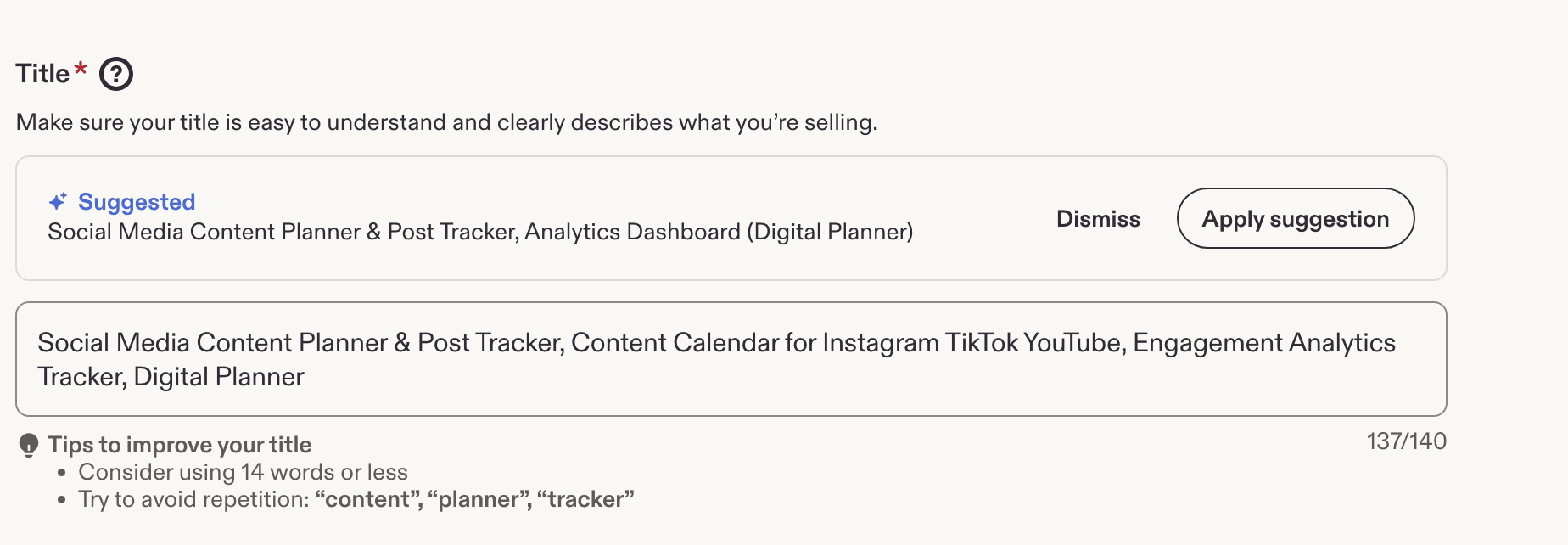
Before — built for the old system 18 words
Social Media Content Planner & Post Tracker, Content Calendar for Instagram TikTok YouTube, Engagement Analytics Tracker, Digital Planner
Eighteen words. “Tracker” three times. “Planner” twice. “Content” twice. Perfectly optimized — for a system that no longer exists.
There's also a subtler problem. My strongest keyword was social media planner, and the word “Content” sits right in the middle of it. Etsy sees “social media content planner,” which is a different phrase. I had the words but not the match.
After — rewritten 12 words
Social Media Planner: Browser-Based Content Calendar & Post Tracker for Instagram TikTok
Twelve words. The noun — planner — stated once. The primary keyword exact and front-loaded. “Browser-based” as the material descriptor, which is the genuine differentiator. No repetition.
Where the removed keywords go
This is where people lose ground. Nothing gets deleted. It moves.
Etsy's own advice before you touch anything: download a CSV of your listings, so you can reference the old titles while updating everything else.
Tags matter more now, not less. Thirteen tags, 20 characters each. Every keyword you pull from a title is a tag candidate — but check it has real search volume first. When I audited mine, ten of my thirteen tags had under 20 monthly searches. They were doing nothing.
| Tag | Monthly searches | CTR |
|---|---|---|
| content calendar | 1,565 | 97% |
| social media planner | 1,393 | 102% |
| social media tracker | 78 | 131% |
Attributes are the most-skipped free ranking signal on Etsy. Search reads them explicitly, and most sellers leave half of them blank. Go through every listing and fill in every field that's genuinely true of the product — then leave the rest empty on purpose. The rule that keeps holidays and recipients out of your title governs this panel too: tag a marketing planner with an occasion and you surface it to gift shoppers who bounce. Click-through is a ranking input now, so a wasted impression costs you twice.
Descriptions carry weight they didn't before. Front-load them — only the first couple of lines show before “read more” on mobile. All the subjective language Etsy just removed from your titles belongs here.
The checklist
For any listing, new or existing:
Title
- Under 15 words
- The noun appears exactly once
- Primary keyword exact-match and front-loaded
- Two or three objective descriptors
- No repeated words
- No “for small business owners” or similar recipient targeting
- No subjective words
- No price, sale or shipping language
Everything else
- All 13 tags used, each verified for real search volume
- Every attribute field that's true of the product filled — the rest deliberately empty
- Description front-loaded, short paragraphs
- First photo legible at thumbnail size — it's a ranking input now
One last thing: give it time
Etsy's own note is worth repeating:
“Changes may take a little while to have an effect, so it can help to give updates some time before deciding what works best for your shop. If something doesn't feel right, you can always revert.”
Etsy Seller Handbook
Change your titles once. Then leave them alone for two or three weeks before judging. Rewriting them again after four days tells you nothing except that you're anxious.
Two related things, if this is work you're doing anyway. The board-versus-pin distinction is what decides where your Pinterest keywords actually land — that's Pinterest keyword research. And if there's a website behind your shop, the keywords you almost rank for are usually a title fix rather than a new page. Same argument as this post, one platform over.
If Pinterest is where your Etsy traffic comes from — and for most sellers it is — the Pinterest SEO Checklist is the same idea applied there. Ten checks to run before every pin goes live, free, on one page.